B2B SEO strategies that scale

Most B2B SEO advice assumes you are starting from zero. It walks you through keyword research, buyer personas, and on-page basics as if you have never touched a search console before.
That is not the problem most VPs of Marketing and CMOs bring to us. Their program already works, at least at the size it was built for. The real question is why a strategy built by a lean, generalist marketing team keeps working as the company scales, right up until it doesn't, especially when that team never grows into specialists. A SaaS company that ranked well with twenty landing pages starts losing ground once it has two hundred, often run by the same small team that built the first twenty.
The fix is rarely more content or a bigger budget. It is a structural shift in how the work gets planned, produced, and validated. We have watched this pattern play out across fintech and compliance software clients, and it repeats often enough to build a framework around it.
What B2B SEO means once you are past the startup stage
At the early stage, this work is mostly a production problem. You need buyer personas, a keyword list, a handful of well-optimized landing pages, and a blog that answers real questions your prospects are typing into Google.
At enterprise or SaaS scale, it becomes a coordination problem instead. You are managing multiple product lines, several buyer personas within a single buying committee, legal and compliance review, and content that has to stay accurate as your product changes every quarter.
| Startup-stage B2B SEO | Enterprise or SaaS-scale B2B SEO | |
|---|---|---|
| Primary challenge | Production: personas, keywords, landing pages | Coordination: product lines, stakeholders, review cycles |
| Buying committee | Often one decision-maker | Multiple personas: VP, director, technical evaluator |
| Biggest content risk | Thin coverage, too few pages | Content debt, cannibalization, stale pages |
| What breaks first | Nothing yet, still building | Team structure and quality control |
That shift matters because B2B buyers do not behave the way most SEO playbooks assume. Gartner's research on the B2B buying journey found that buyers complete roughly 80 percent of their journey through independent, self-service research before they ever talk to a sales rep.
If your content cannot keep pace with that research across a longer, more complex funnel, you are not losing to a competitor.
You are losing to your own bottleneck.
What "scale" actually requires
A B2B or SaaS buying committee usually includes people with different jobs and different search behavior: a VP evaluating strategic fit, a director comparing vendors, a technical evaluator checking implementation details. Enterprise SEO has to speak to all of them without the site feeling scattered.
That means your content has to serve multiple personas at once, stay accurate as your product and positioning evolve, and route each persona to the right stage of content, whether that is an educational guide or a comparison page. Most programs are built for the first requirement and never revisited for the other two. That gap is where scaling problems start.
The real point where B2B SEO stops scaling
We have worked with enough lean marketing teams to see where this consistently breaks. It is rarely the strategy. It is the team structure underneath it.
Generalist marketing teams, the kind you find at most fast-growing B2B and SaaS companies, tend to have a working knowledge of SEO fundamentals but not deep specialization. As output demands grow, they lean harder on AI tools like Claude or ChatGPT to keep the content calendar full. That is not the problem by itself.

If this pattern sounds familiar, it is worth reading how we think about structuring a marketing team for the stage you are actually in, not the stage you started at.
Picture the pattern in practice. A generalist marketer gets assigned six new blog posts for the month, on top of everything else already on their plate. They turn to an AI tool to draft each one, because that is the only way to hit the deadline.
Without SEO-specific prompting, and without the background to know what a search engine actually rewards, they publish six pieces of content that read fine but rank nowhere. Multiply that across a full quarter and you have a content library full of pages nobody finds.
Why publishing more content is not a scaling strategy
Here is a claim that gets repeated in nearly every B2B SEO guide: publish more content to grow organic traffic faster. It is not wrong, exactly. It is incomplete in a way that causes real damage.
More content gives you a larger surface area to rank. But it only earns that surface area if it clears three bars.
It has to meet Google's standard for experience, expertise, authoritativeness, and trust, known as E-E-A-T. It has to say something a reader cannot get from three other articles on the same topic. And it has to support a specific content pillar, not just a keyword. Skip any of those and you are not scaling. You are just creating volume.
This is exactly the trap AI-generated content falls into. AI tools are very good at producing content that sounds complete. They are much worse at including verifiable, first-party data or a distinct point of view.
When teams run a quick human "polish pass" over AI output and call it done, the result is technically published but strategically empty. It fills a keyword slot instead of supporting a pillar.
We have seen the difference this makes firsthand. A fintech client came to us relying almost entirely on AI-generated content with minimal editorial oversight. After rebuilding their content strategy around first-party data and hands-on subject-matter expertise, their organic clicks grew 87 percent year over year, and their average ranking position improved from 33 to 15.
A compliance software client saw a similar pattern after the same shift away from generic, AI-first content. Organic clicks rose 73 percent year over year, with average position improving from 45 to 25.
A quick E-E-A-T check before you publish
Before a piece of content goes live, ask whether it can honestly answer yes to each of these:
- Does it include a data point, statistic, or example that did not come from an AI model's training data?
- Does it reflect a perspective or lesson that came from real client work, not a summary of what other articles already say?
- Does it clearly support a specific content pillar, rather than existing only to target one keyword?
- Would a subject-matter expert on your team be comfortable putting their name on it?
If the honest answer to any of these is no, the piece needs another pass before it publishes, regardless of how close you are to your monthly content quota.
Match your content to keyword intent, not your content calendar
One of the most common mistakes we see in B2B SEO strategy is treating the long-form guide as the default format for every keyword. It is not.
Before committing to a format, look at the intent behind the keyword. Tools like Semrush will tell you whether a term skews informational, commercial, or transactional, and that distinction should drive what you build, not your content calendar.
Take a keyword like "B2B SEO agency." That term carries meaningful search volume and strong commercial intent. Someone typing that phrase is close to a buying decision, and a 3,000-word ultimate guide misses the point entirely. What that searcher needs is a tight, conversion-focused page that answers their question and gets them to a next step.
Compare that to a keyword like "B2B SEO strategy," which skews informational and sits earlier in the funnel. That is exactly where an in-depth guide earns its keep, because the reader is still in research mode and wants a comprehensive answer.
A simple intent-to-format framework
Use this as a starting checklist before you brief any new page:
| Keyword intent | Example keywords | What to build |
|---|---|---|
| Commercial or transactional | "B2B SEO agency," "B2B SEO services" | A focused, conversion-oriented page with proof points and a direct next step |
| Informational | "B2B SEO strategy," "what is B2B SEO" | A comprehensive guide that fully answers the question and earns organic links |
| Mixed or ambiguous | Check what is actually ranking | If the top results mix guides and product pages, build both, targeted at different variations |
Getting this wrong is one of the most common ways B2B and SaaS companies waste writing hours at scale. A quick intent check before every brief saves you from building the wrong asset for the wrong stage of the funnel, on repeat, across dozens of pages. It is a small step with an outsized effect on organic search performance once you are producing content at volume.
Stop copying the top 10, and find your moat instead
Most SEO guides tell you to build content briefs by studying what already ranks in the top 10 and matching its structure. We looked at the top-ranking pages for this exact topic before writing this article, and the advice holds up only so far.
Copying the top 10 runs into one problem. If your brand does not carry as much domain authority as the pages already ranking, and your content says essentially the same thing they do, Google has little reason to rank you above them.
Sameness is not a ranking strategy. It is a ceiling.
The better use of competitive research is finding the gap, not the template. List what the ranking pages leave vague, oversimplify, or skip entirely, then check what your team knows firsthand that none of them show any evidence of having done. That gap is your moat, and the reason someone should read your article instead of the one sitting at position two.
This is harder than filling out a content brief template. It requires a point of view grounded in real client work or a contrarian read on conventional advice. It is also the only realistic path to ranking above competitors who already have more backlinks and more domain history than you do.
Build for AI search visibility without abandoning SEO fundamentals
Marketing leaders ask us constantly whether AI search visibility requires a completely separate strategy from traditional SEO. It does not, and treating it as a separate discipline is itself a mistake.
AI search visibility is another layer on top of the same SEO foundation: a fast site, clean semantic structure, proper schema markup, and content that is not generic. Skip the fundamentals and the rest of the system fails, regardless of how much effort goes into AI-specific tactics.
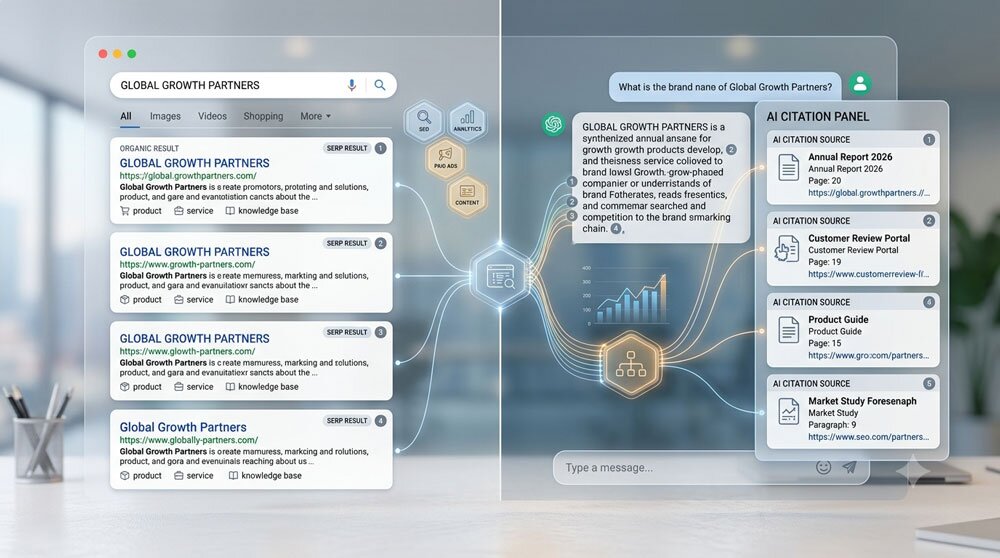
What is genuinely different is the weight AI platforms place on third-party validation. Research from G2 found that domains active across multiple review platforms, including G2, Capterra, and Trustpilot, earn roughly three times higher citation probability than domains without one. If your brand is not showing up where your buyers already look, you are giving AI search engines fewer reasons to cite you.
For B2B and SaaS companies, that means treating review site presence as part of the SEO strategy, not a workstream owned by customer success. Pair that with a real AI search strategy built on solid technical SEO, and you have the best shot at showing up in both traditional rankings and AI-generated answers. For more on how the two disciplines connect, see our breakdown of generative engine optimization.
Where to build third-party validation first
If you are prioritizing where to invest, start with the platforms buyers already trust and AI models already cite most often:
| Platform | Best for |
|---|---|
| G2 and Capterra | Direct product comparisons and verified user reviews |
| TrustRadius | Enterprise software evaluations with longer purchase cycles |
| Gartner Peer Insights | Buying committees that weight analyst-adjacent sources heavily |
| Reddit and industry communities | Unscripted, first-person opinions AI models increasingly pull from |
None of this replaces your website. It reinforces it, giving AI platforms independent evidence that what your site claims is actually true.
Key takeaways
- B2B SEO strategies that scale solve a coordination problem, not a production problem. More writers and more AI-generated drafts will not fix a broken structure.
- The most common breakdown point is generalist teams leaning on AI tools without the SEO expertise to guide or edit the output.
- Match content format to keyword intent. Commercial keywords need conversion-focused pages, and informational keywords need in-depth guides.
- Differentiate from the top 10 instead of copying it. Sameness caps your ranking potential no matter how well-optimized the page is.
- AI search visibility runs on the same SEO fundamentals, plus third-party validation from platforms like G2 and Capterra.
Frequently asked questions
B2B SEO is the practice of improving a business-to-business company's visibility in search engines like Google, targeting the specific terms that buying committees and decision-makers search for during their research process.
B2B SEO targets a smaller group of decision-makers rather than a broad consumer audience, usually involves lower search volumes with higher commercial value, and requires content that supports a longer, multi-stakeholder buying journey.
Yes. AI search visibility is built on the same SEO fundamentals: fast sites, clean technical structure, and credible content. Buyers using AI tools to research vendors still rely on search-indexed content and third-party reviews to validate what they find.
Most B2B and SaaS companies see meaningful movement in six to twelve months, though results depend heavily on current site authority, content quality, and how quickly structural issues like the ones covered here get fixed.
Track organic clicks, impressions, and average ranking position alongside pipeline-influenced revenue from organic traffic, not just raw traffic volume. Click and position growth without downstream pipeline impact is a sign the program needs a content intent audit.
Ready to see where your program is breaking down?
If your B2B SEO strategy worked at your last stage but is not keeping pace with your current one, the fix is rarely more content. It is usually a structural gap between your team, your content intent, and your AI search visibility strategy.
Request your free marketing audit and we will show you exactly where the breakdown is happening.
