Fractional marketing vs in-house team: cost, speed, performance

Every marketing leader eventually hits the same wall. Pipeline targets are climbing, the current team is stretched thin, and the board wants to know what it will cost to fix it. The choice usually comes down to two paths: hire in-house or bring in a fractional team. The fractional marketing vs in-house team decision looks simple until you actually run the numbers on cost, speed, and performance side by side.
Most comparisons stop at salary versus retainer. That is a mistake. The real difference between these two models shows up in how fast each one gets to results, how well it holds up under specialized work, and how much it actually costs once every hidden line item is counted.
This guide breaks down all three factors using current salary data, hiring benchmarks, and real engagement results, so you can make the call with evidence instead of guesswork.
What fractional marketing and in-house teams actually mean
An in-house marketing team is made up of full-time employees on your payroll, reporting into your organization, and dedicated to your company alone. You control their calendar, their tools, and their day-to-day priorities.
A fractional marketing team is a group of senior specialists and strategists who work inside your business on a flexible capacity model, not a single generalist hired part-time. Done well, it is not the same as hiring a freelancer or handing work to a traditional agency.
The distinction matters. Traditional agencies typically manage deliverables from the outside and optimize for output volume. A well-run fractional digital marketing services model embeds inside your operating rhythm, joins your planning cadence, and shares accountability for the same goals your internal team is measured on. That difference in structure is what drives most of the cost, speed, and performance gaps covered below.
Cost comparison: what each model really costs
Cost is where most executives start, and it is also where the comparison gets misleading fastest. Salary is only one line item in a much longer bill.
The real cost of an in-house team
The median annual wage for marketing managers in the United States was $161,030 as of May 2024, according to the Bureau of Labor Statistics. That figure covers base pay only, for one mid-level role.
Salary is typically just 60 to 70 percent of the true cost of an employee. Once you add health insurance, payroll taxes, retirement contributions, bonuses, software, and equipment, a $130,000 hire routinely costs $170,000 to $180,000 fully loaded. Our breakdown of the cost of hiring a marketing team in 2026 walks through a full five-person team example that lands at roughly $1.05 million a year once every cost is counted.
Then there is the cost of getting that team in place. According to SHRM's 2025 Recruiting Benchmarking Report, the average cost per hire is $5,475 for non-executive roles and jumps to $35,879 for executive roles, a figure that rose 21 percent in three years. And that spend buys you a candidate, not a productive employee. Ramp time typically runs three to six months before a new hire is operating at full capacity.

The real cost of a fractional team
A fractional model replaces multiple full-time salaries, benefits packages, software licenses, and management overhead with a single flexible retainer. Tools and platforms are typically included rather than billed separately, which alone can offset $10,000 to $30,000 in annual software costs that most in-house teams absorb on their own, based on benchmarks in our marketing team cost calculator.
"Mid-market leaders consistently underestimate the hidden cost of an in-house team," according to the Digital Hive Labs team. "Recruiting, software, ramp time, paid time off, employment taxes, even the laptops. Many are also used to the traditional agency model, so they initially look at us as a single-channel vendor. We remove that mentality because every discipline is working toward the same goal, not just separate deliverables. Clients should feel like we're part of their team, not another agency."
That structural difference, shared accountability instead of siloed deliverables, is also what keeps fractional retainers from ballooning the way multi-vendor agency spend often does.
Speed comparison: time to first impact
If cost is where the comparison starts, speed is where it usually gets decided. A marketing leader under pressure to show results in a quarter cannot afford a six-month ramp.
How slow in-house hiring actually is
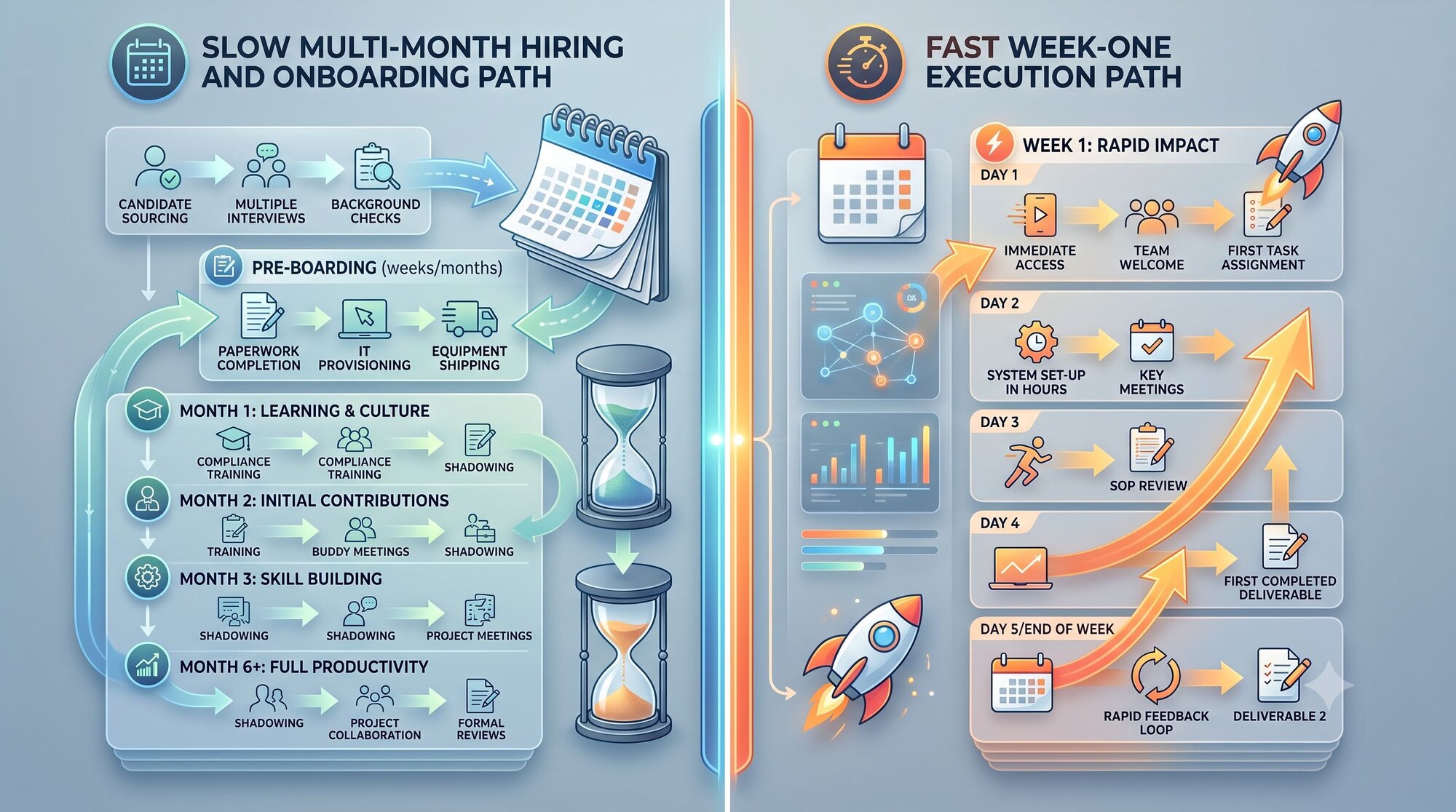
SHRM's benchmarking data puts the median time to fill a role at 44 days, and that is before day one on the job. Layer on three to six months of onboarding and ramp time, and a company can be five to seven months into a hiring decision before a new marketing manager is contributing at full capacity.
For companies trying to fill multiple specialized roles at once (SEO, paid media, content, analytics) that timeline compounds. Each hire runs its own 44-day search-and-fill cycle, often in parallel with competing priorities on an already stretched hiring manager's calendar.
How fast a fractional team can move
A fractional model starts from a different baseline: the team is already built, already trained, and already working together before your engagement begins. In the first 30 days of a typical Digital Hive Labs engagement, clients have seen:
- Over 83 percent improvement in mobile and desktop site performance (Lighthouse scores)
- 100 percent site and channel data visibility through analytics dashboard setup
Those are foundational fixes, not vanity metrics, but they set up everything that follows. Within six months, engagements have produced:
- Over 73 percent improvement in organic impressions for a compliance industry client
- Over 65 percent AI mindshare uplift across major LLMs for a fintech client's category mentions
- A 108 percent increase in paid search traffic and engagement for a compliance industry client
- Over 70 percent improvement in organic search conversion rate for a compliance industry client, and a 188 percent uplift for a fintech client
- A 50 percent improvement in paid channel conversions while cutting spend by 57 percent for a compliance industry client
That speed is a direct result of the execution model. Our fractional digital growth expertise approach embeds specialists who run campaigns and manage channels from week one, instead of spending the first quarter building a team from scratch.
Performance comparison: specialization, accountability, and output quality
Speed gets attention, but performance over the long run is what actually matters to a CMO or VP of Marketing being measured on pipeline. This is where team structure, not headcount, becomes the deciding factor.
According to Gartner's 2026 CMO Spend Survey, marketing budgets have flatlined at 7.8 percent of company revenue, roughly 18 percent lower than four years ago. Leaders are being asked to produce more with a budget that is not growing. That makes structural efficiency, not additional headcount, the real performance lever.
Where in-house teams tend to lose performance
According to the Digital Hive Labs team, the most common structural mistake in mid-market marketing teams is generalists covering too many channels at once, without senior strategic leadership setting priorities, or a leader trying to manage several disconnected vendors with no alignment between them. When one person owns SEO, paid, content, and analytics simultaneously, all four suffer.
That mirrors what shows up in salary data. A single $99,000 SEO/marketing manager or an $87,000 digital marketing manager is rarely deep enough in any one discipline to compete with a specialist, yet that is exactly the role many mid-market teams lean on to cover multiple channels.
Where the fractional model holds an advantage
A fractional structure is built around full-stack specialist coverage instead of one or two generalists. Comparing the two models directly:
Factor In-house Fractional Time to ramp up 3 to 6 months Productive in week one Expertise breadth Siloed to one discipline Full-stack team of specialists Bench depth Single point of failure Cross-trained coverage built in Risk if someone leaves High, restart hiring Seamless team continuity Vacation and sick coverage Marketing slows down Team covers gaps automatically This structure is also why a fractional model can outperform a traditional agency. Agencies are typically measured on campaign-based deliverables. A full-time hire is measured on individual KPIs within one department. A properly embedded fractional team carries shared accountability across every channel toward the same business outcome, which is what produces the compounding results shown in the speed section above.
Where each model breaks down
Neither model is automatically right. Each one fails under specific, predictable conditions.
Common in-house mistakes
Beyond generalists covering too many channels, in-house teams break down when leadership is thin or absent, so execution happens without a strategic filter. Vendor fragmentation compounds the problem: separate agencies for SEO, paid media, and web development, each optimizing for their own scope, with no one accountable for how the pieces fit together.
Common fractional mistakes
Fractional engagements underperform when the partner behaves like a traditional agency instead of an embedded team, showing up for deliverables without real ownership of outcomes. The label "fractional" does not guarantee an embedded operating model. Leaders evaluating a fractional partner should ask directly how shared dashboards, decision cadence, and accountability are structured, not just what services are included.
The misconception that costs leaders the most
The most expensive mistake is assuming fractional means a lesser tier of talent at a lower price. In practice, a fractional retainer often buys senior-level expertise across multiple disciplines that a mid-market budget could never staff full-time. The real trade-off is not quality. It is how the work is structured and who owns the outcome.
How to decide: a simple framework
Choosing between fractional marketing and an in-house team comes down to three practical questions, based on patterns the Digital Hive Labs team sees across engagements:
- Is the current team's workload bigger than its capacity? If work is backing up regardless of effort, that is a capacity problem, not a talent problem.
- Do you have generalists but no specialists? A team of two or three people covering every channel is a signal that depth, not headcount, is the gap.
- Does your budget support full headcount across every discipline you need? If not, a fractional model can deliver specialist coverage a full in-house build cannot afford yet.
If two or more of these apply, a fractional model, or a hybrid of embedded fractional leadership paired with core in-house execution, typically closes the gap faster than another round of hiring. Structuring that internal capacity over time is exactly what our digital teams development work is built for, and companies weighing a single senior hire against ongoing strategic support often benefit from comparing options with fractional growth leadership directly.
Key takeaways
- Salary is only 60 to 70 percent of the true cost of an in-house hire once benefits, taxes, tools, and recruiting are included.
- SHRM data shows a 44-day median time to fill a role, followed by three to six months of ramp time before full productivity.
- A fractional model can be productive in week one, with measurable technical and visibility improvements inside the first 30 days.
- Gartner's 2026 CMO Spend Survey shows marketing budgets flat at 7.8 percent of revenue, making team structure a bigger performance lever than added headcount.
- The most common in-house failure point is generalists covering too many channels without senior strategic leadership.
Frequently asked questions
Usually, yes, once fully loaded costs are counted. A single in-house marketing manager can cost $170,000 to $180,000 fully loaded, while a fractional model typically delivers broader specialist coverage inside one flexible retainer with tools included.
Foundational improvements, like site performance and analytics visibility, can show up within the first 30 days. Measurable channel performance gains typically follow within three to six months, compared to three to six months just to onboard a single in-house hire.
It depends on your stage. Many mid-market companies use a hybrid model: fractional leadership and specialist execution supporting a smaller internal team that owns day-to-day brand and stakeholder relationships.
When workload consistently exceeds capacity, when the team is all generalists with no specialists, or when budget cannot support full headcount, that is typically a signal to bring in fractional support rather than add another generalist hire.
Yes. Fractional teams with sector experience have driven measurable gains in regulated spaces, including significant organic conversion rate and AI-search visibility improvements for compliance and fintech clients.
Ready to see the real numbers for your team?
Salary comparisons only tell part of the story. See exactly what a full-stack fractional team would cost against your current structure with our marketing team cost calculator, or book a strategy call to walk through your specific team gaps with the Digital Hive Labs team.
