Web developers vs engineers: why marketing needs its own technical team

The everyday story that starts this conversation
Can we launch this landing page before Friday?
And in that moment, campaign momentum disappears.
At Digital Hive Labs, we see this pattern everywhere. A company’s marketing team has ideas, urgency, and data, but they depend on engineering’s bandwidth to make anything real. The result? Campaigns slow down, experiments die halfway, and business leaders start doubting marketing’s agility.
It’s not a talent issue. It’s a workflow mismatch between product engineers and marketing web developers.
Why “they can code, so they can do it all” is a misconception
On paper, it feels logical: product engineers already manage the tech stack, so why not let them update the website too?
But writing JavaScript for a SaaS app is not the same as building a page that converts leads, loads fast, and ranks on Google.
Just as your primary doctor doesn’t perform heart surgery, your software engineer isn’t the best choice for your marketing website’s daily evolution. They have overlapping skills, but different rhythms, mindsets, and success metrics.
A Forbes 2025 comparison of web platforms highlights this difference clearly: tools and workflows that help apps scale are rarely those that keep marketing sites nimble.
Two worlds, two rhythms, one friction point
Product engineering operates on sprints, stability, and structure. Success \= predictable releases and technical health.
Marketing web ops, by contrast, lives in a world of launches, tests, and iterations. Success \= speed, influence, and measurable lift.
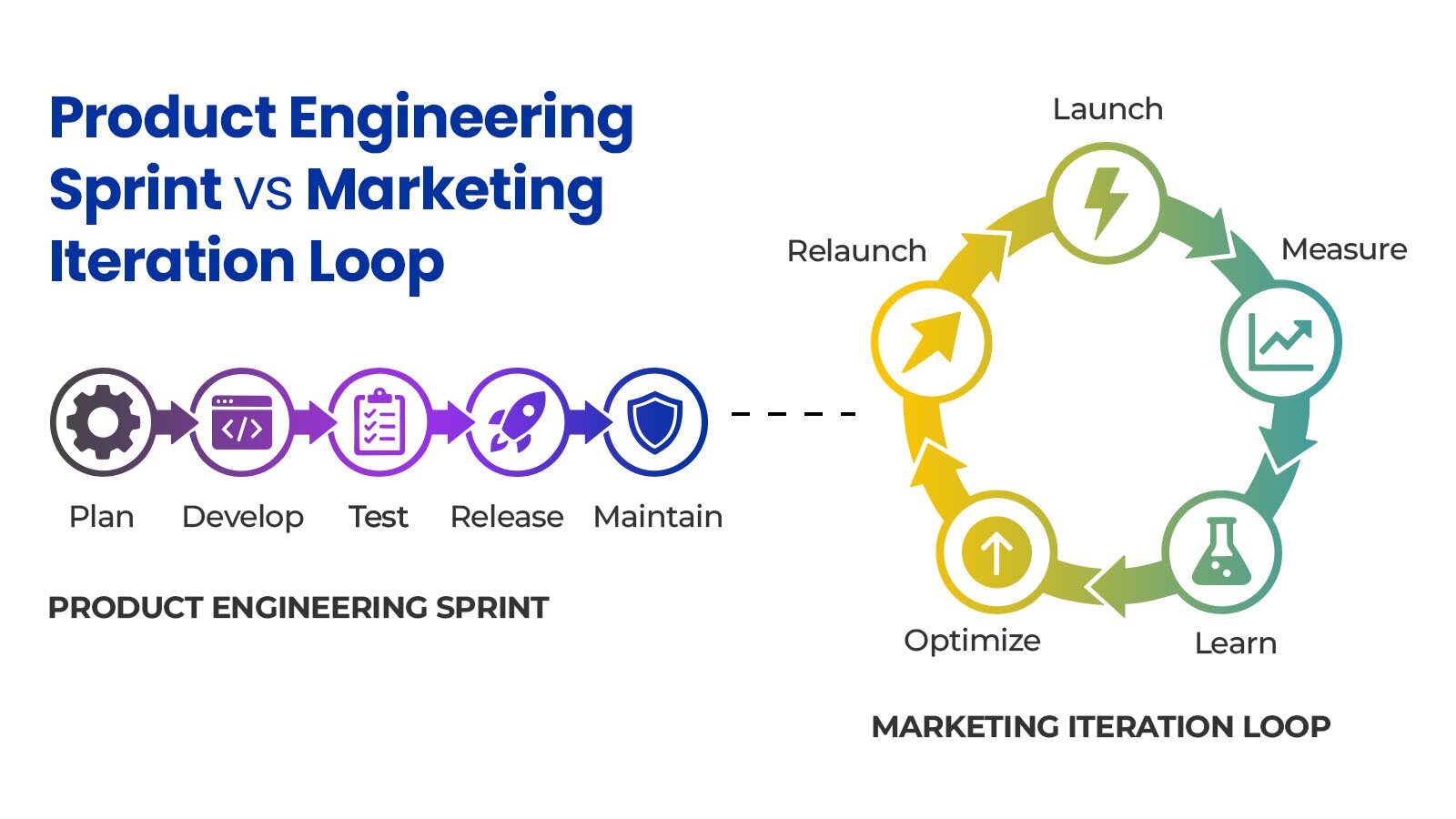
When these worlds collide in one backlog, someone loses. Marketing grows frustrated waiting for dev time. Engineers feel distracted by “tiny” website requests. And conversion opportunities leak through the cracks.
That’s exactly why marketing ops now includes marketing web ops, a standalone track designed to remove friction yet stay aligned with engineering standards.
The specialist analogy that explains it best
Picture your digital ecosystem like a hospital.
- Engineers are the surgeons, steady, cautious, and focused on systemic health.
- Marketing developers are the rehab experts, making sure the patient (your website) performs at its best every day.
Both are technical. Both matter deeply. But expecting one to substitute for the other is costly.

When marketing leaders present this distinction inside their org, internal buy‑in comes naturally. The conversation shifts from “Why can’t engineering just do this?” to “Let’s use each team where it creates the most impact.”
What a marketing web ops partner actually does
When brands work with a marketing web ops partner like Digital Hive Labs, the transformation usually follows a predictable arc:
1. Campaign speed multiplies
No more waiting on engineering cycles. Code‑safe updates, campaign templates, and CMS workflows let marketing launch same‑day without bypassing quality controls.
2. Design stays consistent, without bottlenecks
Our teams build modular design systems and reusable components so updates stay on‑brand and fast.
3. Experiments get executed, not delayed
Better ops means A/B testing, CRO, and SEO changes actually ship. Pages evolve from static brochures into living testing environments.
4. Data drives iteration
Ongoing audits of Core Web Vitals and analytics dashboards highlight performance trends that non‑technical marketers can act on, fast.
Seeing results: what changes after implementation
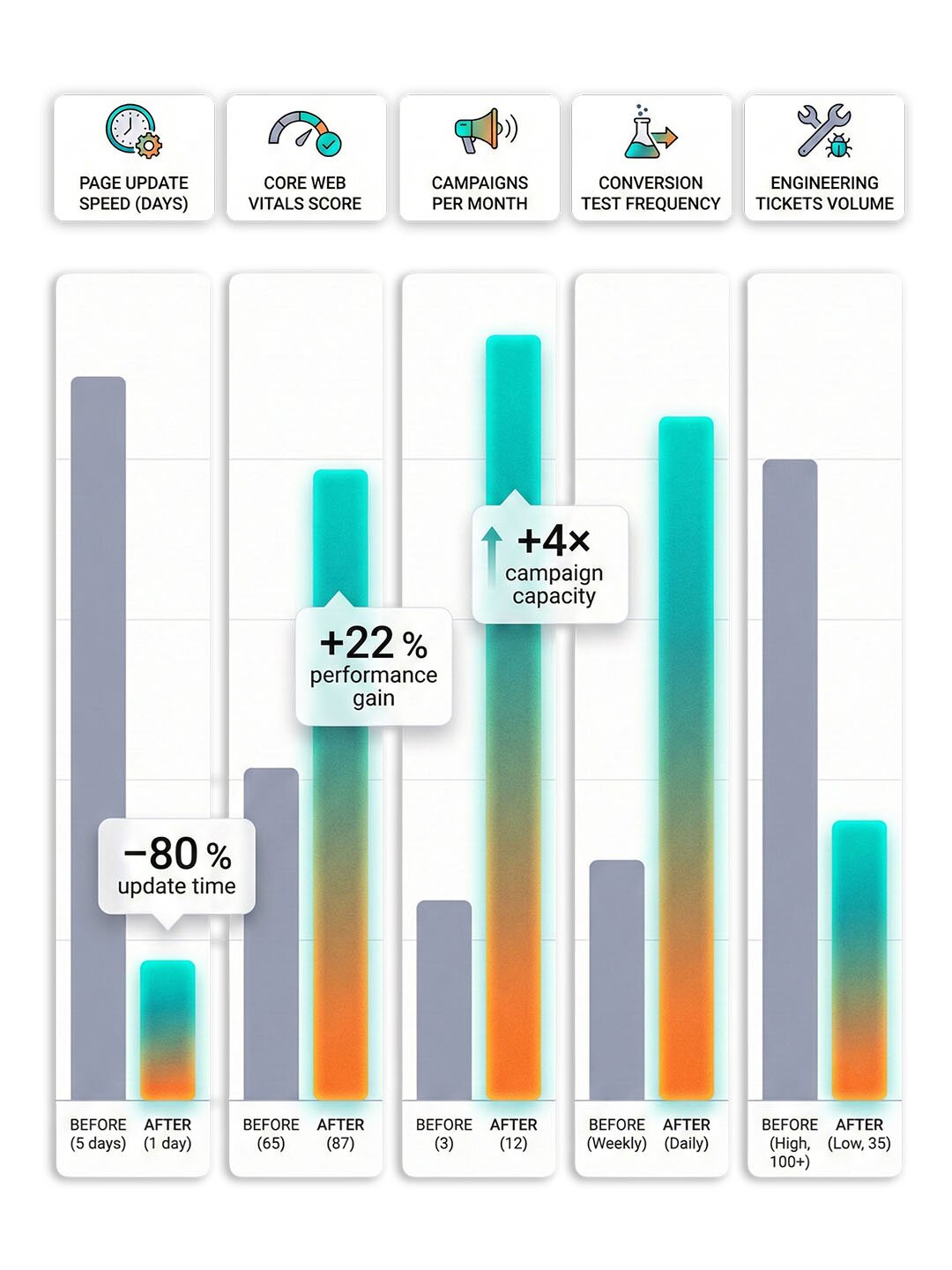
Once a dedicated marketing web ops process is set up, results compound fast:
Metric Before web ops After web ops Page updates 10–14 days 1–2 days Core Web Vitals 65 average 85+ average Campaigns launched 1–2/mo 4–6/mo CRO test cycles Every 8 weeks Weekly Engineering tickets from marketing High Down 50 % Performance lifts often align with improvements in SEO best practice such as faster load time, structured content, and better link consistency.
Not competition, only collaboration
The goal isn’t to pull marketing work away from engineering. It’s to let each team operate at full capacity.
When we introduce marketing web ops to a client:
- Engineers gain back focus for critical releases.
- Marketing gains agility to execute nonstop.
- Leadership gains visibility across both.
Engineering and marketing stop stepping on each other’s toes and start dancing in sync.
The new core skills every marketing org needs
To sustain this collaboration, modern marketing teams must adopt a hybrid mindset:
- Governance – Define ownership between code, content, and brand assets.
- Automation – Deploy changes through CI/CD pipelines instead of waiting for dev pushes.
- Design systems – Ensure consistency with scalable component libraries.
- Performance tracking – Treat site speed and SEO health as campaign metrics, not IT chores.
The bigger picture: marketing is getting more technical
Marketing web ops is the evolution of modern marketing. It blends creativity, analytics, and code in a single operating model. The marketer of tomorrow isn’t less technical, they’re strategically technical.
As platforms grow more composable, this hybrid discipline determines how brands scale, iterate, and stay visible. Marketing velocity becomes a KPI, not an afterthought.
Key takeaways
- Product engineers and marketing web developers operate on different mandates.
- Marketing needs ownership of the website experience to move quickly.
- Marketing web ops improves agility while maintaining system integrity.
- Collaboration between tech and marketing yields faster growth.
- Investing in web ops now builds long‑term efficiency and higher ROI.
FAQ
Engineers build and maintain products. Marketing developers build and maintain awareness. They code with different end goals and workflows.
No. It supports it. Each team focuses where it adds maximum value without creating cross‑team delays
Usually a headless CMS such as Webflow, WordPress, Builder.io, or Contentful, automated deployment via Git, and analytics integrations that surface SEO, CRO, and Core Web Vitals data.
Track update velocity, Lighthouse improvements, SEO gains, conversion lifts, and reduced dependency on engineering queues.
Conclusion
The difference between success and stagnation often comes down to one thing: speed. And speed is impossible when marketing depends entirely on engineering.
Marketing web ops gives your team independence, structure, and focus, without compromising code quality or brand integrity.
If your website changes require submitting a ticket and waiting for the next sprint, it’s time to change the system.

